⟨⟨ Back to Requests for Proposal
| RFP Name | REQUEST FOR PROPOSAL FOR SHOALWATER BAY TRIBAL CAMPUS ROAD FOR THE SHOALWATER BAY INDIAN TRIBE |
|---|---|
| RFP No. | P-2027-1 |
| Open Date | October 7, 2026, 12:00 PM |
Project Description
The Shoalwater Bay Indian Tribe (the Tribe) has been planning a move to higher ground since 2009, as its community is located within the predicted inundation zone of a Cascadia Subduction Zone-triggered tsunami. This move entails relocating both residents and public buildings and providing adequate infrastructure to serve new homes and buildings. The area for the first homes and tribal public buildings has been identified in the uplands northwest of the existing community near Tokeland, Washington. Design and construction of the main entry road to the relocation area, Eagle Hill Road, is underway. This project continues the Tribe’s momentum by starting the process to create the road and parking infrastructure for the tribal campus, where many of the Tribe’s public buildings will be situated according to the Relocation Master Plan. This project will result in the creation of 30% design plans for the Tribal Campus Road which will loop from Eagle Hill Road to the west, serving public building slated in the Master Plan to potentially include a Justice Center, a new administration building, a new clinic, afterschool program, museum and gym/emergency shelter and then return to Eagle Hill Road. The area will require significant grading, so conceptual design work with an architect will need to be completed, as well as conceptual grading, utility, and road design to determine the proper alignment for the road. Geotechnical engineering, topographic survey and environmental review of project effects are also included in the scope of this request. The project is anticipated to take one and a half years after grant award to complete, likely spanning mid or late 2026 to early 2029.
For full description click here
Scope of Work
QThe work to be undertaken as part of the grant is vital to advancing the Shoalwater Bay Indian Tribe’s move to higher ground (known as munk-saxali náḿsčać). Tribal Campus Road will serve as a frontage road, reducing traffic at the main intersection (Eagle Hill Road and the ridgeline road) and minimizing conflict points by consolidating driveways. This approach concentrates traffic on the frontage road, which is especially important in the steeper areas. The road willalso create a loop for future transit stops at the neighborhood center, making it easier for buses to access and return to Highway 105.
The project scope includes the conceptual design of the road and parking for the tribal campus, with necessary components such as environmental review, topographic survey, site design, civil engineering, and second-level engineering review. Community engagement will be a key part of the process, providing opportunities for the public to learn about the project and offer feedback on the road and buildings. The survey will provide critical data for the design engineers, enabling them to create road alignment drawings and determine earthwork needs. An architecture firm will assist in layout, ensuring that the road supports efficient site development for the buildings.
The conceptual design will guide the engineers in grading, stormwater management, and whether soil from construction can stay on-site or needs to be removed. The Tribe doesn’t have an engineer on staff, so the second-level review will ensure the plans are accurate and comply with Tribal codes. The scope also includes community engagement. Construction documents cannot be prepared without conceptual drawings and site reconnaissance. Without this road, the infrastructure for public buildings cannot be completed.
Consultants will be contracted to undertake all tasks in this project. These will include civil engineers, architects, electrical engineers, environmental consultants, and surveyors. Award of a contract will be made to the bidder offering the lowest price and/or greatest value to the Tribe considering price, technical, and other factors as specified in the solicitation.
Questions & Answers
Question: Would you consider extending the deadline for proposals by two weeks to allow us to thoughtfully develop a project work plan, schedule, and budget?
Answer: At this time, we will not consider extending the deadline.
Question: Please confirm the proposed tribal campus road follows the alignment I highlighted
from the master plan, Figure 34: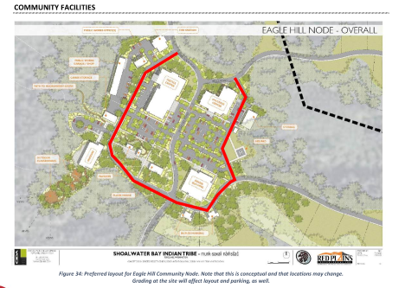
Answer: The project text confirms the road will loop from Eagle Hill Road to the west, serving the flatter area designated for the tribal campus public buildings before returning to Eagle Hill Road. It will serve as a frontage road to reduce traffic at the main intersection of Eagle Hill Road and the ridgeline road.
Question: Confirm the RFP scope does not include design for driveway approaches, parking lots, and building elevations.
Answer: The RFP scope explicitly includes the conceptual design of parking for the tribal campus. It also incorporates conceptual site layout and mass grading assisted by an architecture firm to establish building footprints. While detailed building elevations are not listed, parking infrastructure is directly inside the scope, and driveways will be consolidated into the frontage road design.
Question: Please confirm that no existing subsurface utilities are in the project area.
Answer: The project text specifies that the area requires conceptual utility design alongside grading and road design. Although the area is in undeveloped uplands traditionally accessed by primitive logging roads, a topographic survey and site reconnaissance are required to determine the proper alignment and utility routing. The presence or absence of hidden subsurface obstructions will be formally established by these tasks.
Question: Confirm the stormwater approach in the Master Plan, page 70 does not apply to the proposed roadway. Vegetative filter strips in this alignment may not be feasible with build up areas on each side of the project.
Answer: The conceptual design must guide the engineers in grading and stormwater management. If build-up areas restrict the use of the specific vegetative filter strips outlined on page 70 of the Master Plan, the contracted civil engineer is responsible for adjusting the 30% design to use alternative stormwater management solutions that fit the actual topography and lateral constraints.
Question: Please confirm the expected scope of environmental review for this project. Has the Draft Environmental Assessment (Master Plan, Pg 27) been submitted to the lead Federal or State agency with approved findings?
Answer: A dedicated $15,000 budget is set aside specifically for an environmental consultant to complete this task. The provided text indicates that preliminary environmental investigations (e.g., wetlands) have been completed. However, the final 30% design package, funded by this grant, will ultimately produce the necessary documentation for formal agency submission, including the environmental review of project effects.
Question: Please confirm the $312,200 grant received is for this 30% design only.
Answer: The project is 100% funded by this current RTA Program application of $312,200. The narrative explicitly states that non-federal funding is 0% ($0), other federal funding is 0% ($0), and no other funding is anticipated to be spent. It is strictly for the conceptual/30% design phase.
Question: Please confirm that topographic survey and geotechnical report are part of this RFP.
Answer: The text explicitly dictates that geotechnical engineering and a topographic survey are included in the scope of work.
Question: Please confirm if the design for Eagle Hill Road, campus buildings, circulation, and parking lots are ongoing, and if the awarded firm should coordinate the road design with other consultants.
Answer: Design and construction of the main entry road, Eagle Hill Road, is already underway under a separate effort. The awarded team must include civil engineers, architects, electrical engineers, environmental consultants, and surveyors who will coordinate closely to align the loop road, utilities, and grading with Eagle Hill Road and the building footprints.
Question: The mandated second-level engineering review is to be performed in-house by the awarded firm’s QC staff.
Answer: The Tribe does not have an engineer on staff, so a second-level review is built into the grant to ensure compliance. However, because the Tribe contracts out all tasks to consultants, this QC function is explicitly listed as a separate budget item of $5,750 and will be performed by a contracted engineering reviewer to verify the primary designer's plans.
Question: Expected number of public engagements for this project.
Answer: Proposers should define a realistic meeting schedule (e.g., 2–3 workshops) to capture public feedback on the road and building layouts.
Contact Us
Please email solicitations@shoalwaterbay-nsn.gov with you submissions and questions. Please make sure to include your name, company & email.