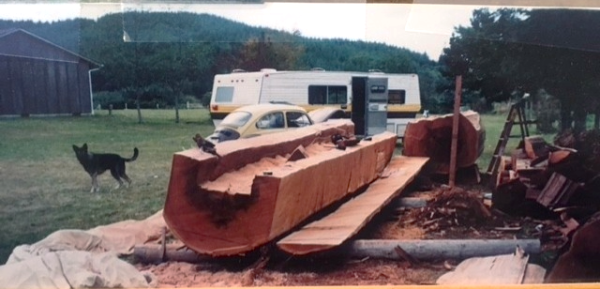
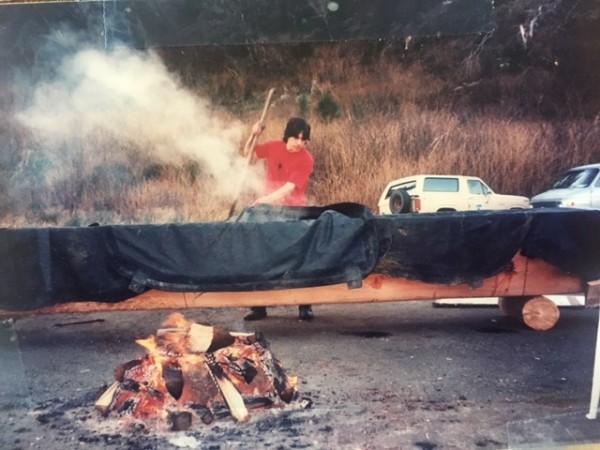
Photos taken from the canoe building process.
Indigenous people are resilient, and the Shoalwater Bay Tribe is no exception. Despite the attempts of the US government to eradicate indigenous languages, cultures, society and traditions, our tribe has been dedicated to the preservation and renewal of our culture since the 1970’s. One of these efforts began through the summer youth program, first run by tribal member Joan Shipman, which still continues today. Now, the Summer Youth Program is a blend of workforce training, language classes, cultural teachings and field trips, spanning across many of the departments of the tribe. Tribal member Sabina Harris remembers working in the cemetery in the 1970’s when she was a summer youth, and now her grandsons take part in the program. Quintin Swanson, current tribal chairman and education department director also took part in Summer Youth, and now he is the director the program.
Shoalwater Bay is a water people and traditionally we traveled by way of canoe, (like the one in the back of the museum!) Another revitalization effort was tribal member Tom Anderson, who was the first in many years to carve a canoe in the traditional way “The canoe was approximately 23 feet long. Thinking back on it, it was a process that went on and on, and it took as long as it took. Maybe 6 months to finish it. It was a struggle…. It wasn’t an ideal log, and every knot that was in the log I had to made a patch for. You couldn’t find the proper tools online at that time, so I made just about every tool I used for it, including a modified adze that weighed about 5 pounds.” Many of our tribal members also participate in Canoe Journey, traveling with our sister tribe, the Chinook Indian Nation. Mary Johnson, tribal member, is one of the rare woman skippers.
Our most recent efforts in our tribe’s cultural department have been focused around weaving and language. We have been gathering sweetgrass and other weaving materials at traditional gathering sites, and holding classes to bring back these skills for our tribal community. Tribal member and culture bearer Kristine Torset has been instrumental in these projects. “I focus on weaving because that’s what I personally enjoy doing as a traditional activity. Recently, I realized that it also lends itself to art. Image revitalization… A lot of our traditional images were placed onto baskets and told stories. So bringing those practices back is vital to our community in a myriad of ways, that captures the art aspect (images) tactile (working with the fiber), and the storytelling through the baskets.